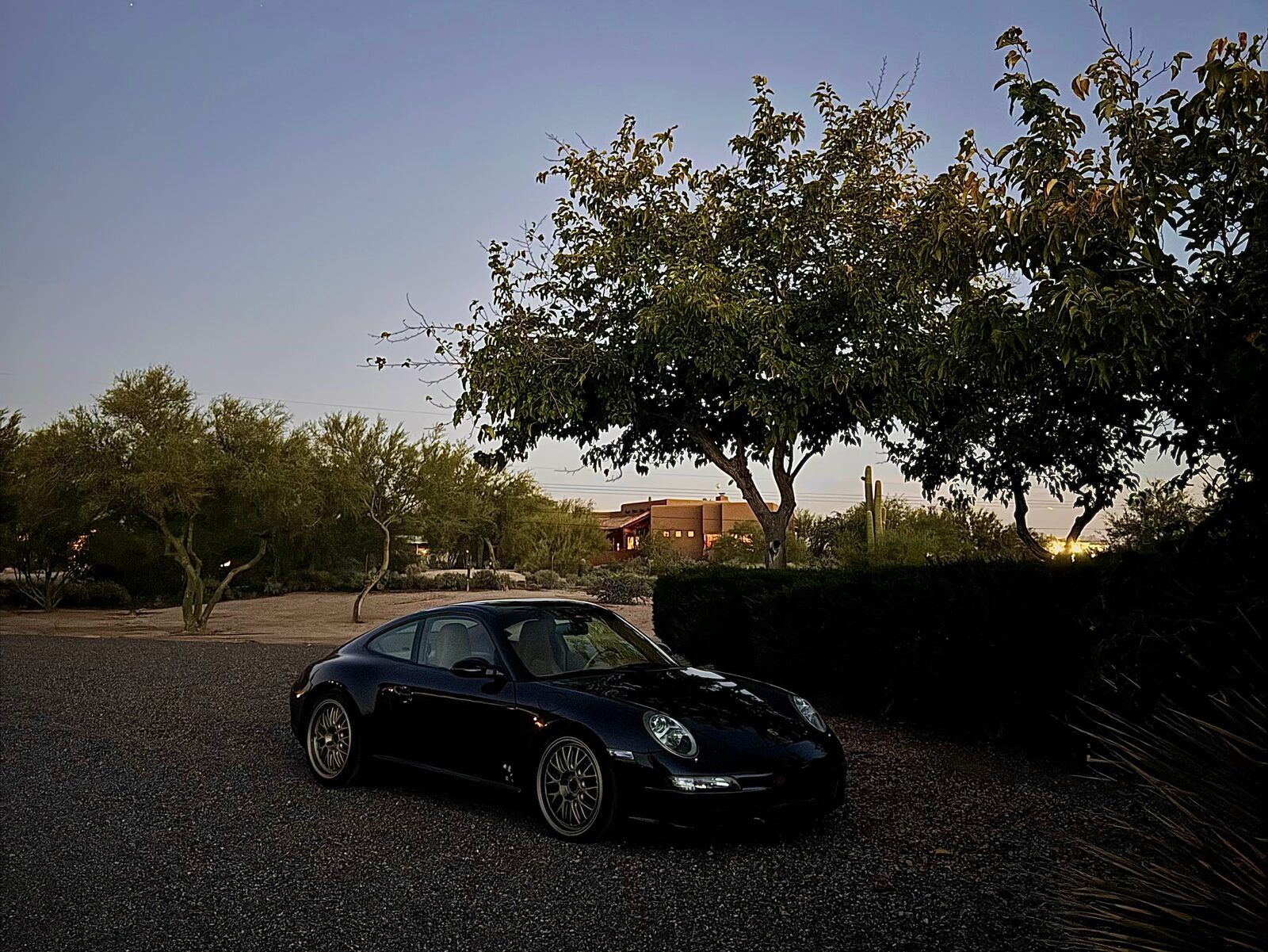
Data article. Oil analysis from one 2006 Carrera 4S and 56 owner-posted reports, Porsche's approved oil list dated Sep 22, 2026, and oil prices checked Nov 16, 2026. Sources are listed at the end.
My 997.1 Carrera 4S passed 200,000 miles this year. It has run Driven DT40 for most of the last 6 years because that's the oil LN Engineering and Flat Six Innovations tell M96 and M97 owners to use. A 12-quart case from LN is now $275.88, and my car takes 10 quarts with a deep sump. Before this oil change I wanted to know if that money buys anything I can actually measure.
So I pulled every Blackstone report I have on the car, 10 of them going back to 2018. Then I compared them against 56 used oil reports posted by owners on Rennlist and other forums, Porsche's current approved oil list, the published spec sheets, and what LN and Flat Six say themselves.
TL;DR
I couldn't find any data showing that oil brand causes, worsens, prevents or slows bore scoring. Wear metals in my car and in the forum reports look the same on DT40, Mobil 1 0W-40 and Motul 8100 X-cess. DT40 does carry far more moly and holds its viscosity better over an interval. In theory the moly might help a little, but nobody has published data showing it makes an M97 last longer. I'm switching to Mobil 1 0W-40 at this change and will keep sending samples to see if anything moves.
The car and how it's been run
It's a 2006 Carrera 4S with the 3.8 M97, manual gearbox, about 202,500 miles. It has an LN deep sump, an LN oil pressure relief kit and an LN 160F thermostat. Oil gets changed every 3,300 to 5,000 miles, and a sample goes to Blackstone most times. The air oil separator was replaced in October 2026 at about 201,400 miles (more on why that matters below).
Oil history in short: unknown oil under the previous owner through early 2020, Mobil 1 0W-40 for one interval in 2020, then DT40 for nearly every change since. There was a Mobil 1 0W-40 Euro stretch in 2021 and 2022 without any samples, and one fill of Driven break-in oil in 2022.
What 10 Blackstone reports show
| Sample | Oil | Miles on oil | Aluminum | Iron | Copper | Silicon | Moly | Zinc | Phos. | Visc. (cSt at 100C) |
|---|---|---|---|---|---|---|---|---|---|---|
| Oct 2018 | Not recorded | 3,500 | 4 | 9 | 4 | 7 | 83 | 1,004 | 916 | 12.72 |
| Feb 2020 | Not recorded | 4,607 | 5 | 6 | 5 | 5 | 69 | 923 | 850 | 15.17 |
| Oct 2020 | Mobil 1 0W-40 | 4,814 | 4 | 9 | 9 | 7 | 76 | 1,012 | 938 | 12.38 |
| Dec 2020 | DT40 (first fill) | 5,043 | 11 | 9 | 6 | 12 | 438 | 1,199 | 1,084 | 13.22 |
| Feb 2021 | DT40 | 3,114 | 7 | 7 | 4 | 16 | 482 | 1,161 | 1,027 | 11.71 |
| May 2025 | DT40 | 4,500 | 6 | 4 | 2 | 9 | 476 | 1,043 | 1,001 | 11.98 |
| Aug 2025 | DT40 | 4,700 | 2 | 3 | 3 | 9 | 552 | 1,246 | 1,158 | 12.77 |
| Nov 2025 | DT40 | 3,438 | 5 | 4 | 6 | 10 | 451 | 1,119 | 918 | 12.36 |
| Feb 2026 | DT40 | 4,330 | 6 | 5 | 3 | 12 | 499 | 1,274 | 1,021 | 11.66 |
| Jul 2026 | DT40 | 4,175 | 6 | 6 | 5 | 11 | 450 | 1,241 | 1,005 | 13.24 |
| Lab average, 3.8 | 5 | 8 | 6 | 6 | 106 | 1,001 | 885 |
All values in parts per million except viscosity. Lab averages are Blackstone's figures for the Porsche 3.8 printed on the July 2026 report. The 2020 Mobil 1 oil is taken from the car's maintenance log, which shows Mobil 1 top-ups during that interval.
Wear metals stayed low on both oils in one 200,000-mile 997
Aluminum and iron from 10 Blackstone reports on the same 2006 Carrera 4S. Dashed lines are the lab's averages for this engine: 5 for aluminum, 8 for iron.
Across 7 DT40 samples the car averaged 6.1 ppm aluminum, 5.4 iron and 4.1 copper. Iron and copper sit under Blackstone's averages. Aluminum sits about 1 ppm over. Blackstone called every one of these reports normal.
The one Mobil 1 sample from 2020 came back at 4 aluminum, 9 iron and 9 copper. The next sample, on the first fill of DT40, showed 11 aluminum. That's one sample on each side and a switch in between, so I wouldn't read anything into it. It just doesn't point toward DT40 either.
Moly is the real difference in DT40
Moly is where DT40 stands apart
Molybdenum (ppm) in the same car's used oil. The lab's average for this engine is 106.
Every DT40 sample came back with 438 to 552 ppm molybdenum. The Mobil 1 sample had 76 and the lab's average for this engine is 106. That gap holds sample after sample. Zinc and phosphorus are a different story. The used DT40 in my car ran 1,043 to 1,274 zinc and 918 to 1,158 phosphorus. That's roughly 15 to 25% above the Mobil 1 sample, a long way short of the 1,482 zinc and 1,319 phosphorus in the 2021 virgin oil test that gets passed around online.
So does all that moly do anything? Moly is a friction modifier. Where metal parts rub with almost no oil film between them, it leaves a thin layer of molybdenum disulfide, a solid lubricant. A 2020 University of Leeds study ran the same engine on the same oil with and without about 1,000 ppm of moly. Friction dropped 0.5 to 1.5% at higher rpm and up to 2.5% at 1,000 rpm. The film formed at the top and bottom of the piston stroke on the cylinder wall and on the cam lobe tips, the places that see the least oil film. That test engine was a 1.2 liter Nissan with steel liners, not an M97. And it measured friction, not necessarily wear. So moly does cut some friction. I couldn't find any data showing that the extra moly in DT40 reduces bore wear or scoring in these engines, though. In theory it might help a little. Scoring starts when the oil film breaks down and metal touches, and that is where moly does its work. But I'm not an engineer, and in that test the moly film only formed on iron surfaces, not on the aluminum-silicon piston skirt. The bores in these engines are aluminum-silicon too, so tough to say if moly makes a big difference in this case.
The DT40 formula has changed
Starting in November 2025, magnesium in my samples jumped from about 10 ppm to between 275 and 435. Calcium dropped from about 1,600 to 1,800 down to about 1,200 to 1,300. Those are detergent additives, so the additive package changed. Driven's safety data sheet also lists a formulation change in its November 2022 revision. Any test you see from before then may not describe the oil you buy today.
Viscosity
Blackstone's normal range for a 40 weight starts at 11.6 cSt. My DT40 samples finished between 11.66 and 13.24. The February 2026 sample came within 0.06 of that floor. The 2020 Mobil 1 sample finished at 12.38, right on the DT40 average of 12.4.
Oil consumption
Make-up oil per interval ran 1 to 1.5 quarts for years, then 2 quarts, then 3.5 quarts in the interval ending July 2026. Rising consumption is one of the early signs of bore scoring, so that number worried me more than anything in the lab reports. The air oil separator was replaced in October. The current interval has used 1.5 quarts over about 3,300 miles, which puts it back in line with earlier intervals. The old AOS looks like the cause. A borescope is still the only way to know what the bores look like. LN's own borescope page makes the same point about oil analysis.
What 56 forum oil reports show
I collected 56 used oil reports that owners posted on Rennlist, 6SpeedOnline, Planet-9, 986forum and others. 35 came from M97 engines like mine (997.1 and 987 Cayman S). 8 had no stated oil and 12 were from the later 997.2 engine, so those are left out of the comparison below. 44 of the 56 came from Blackstone.
Forum oil analyses show no clear winner on wear
Median ppm in M97 engines (997.1 and 987 Cayman S) at roughly 3,000 to 6,000 miles on the oil.
| Oil (M97 only) | Samples / cars | Median miles on oil | Iron | Aluminum | Copper | Visc. (cSt) |
|---|---|---|---|---|---|---|
| Driven DT40 5W-40 | 9 / 5 | 4,000 | 6 | 3 | 5 | 12.8 |
| Mobil 1 0W-40 | 7 / 6 | 4,822 | 9 | 5 | 8 | 11.9 |
| Motul 8100 X-cess 5W-40 | 6 / 3 | 4,725 | 7 | 2 | 5.5 | 12.0 |
DT40 looks slightly better on paper. Two things weaken that. Mobil 1's group includes one 10,000-mile change with 16 iron and 15 copper, and its intervals run longer overall. Most of the DT40 rows also come from 2 very careful owners who change oil early and run magnetic drain plugs. So part of that gap could just be how those cars are looked after.
Same-car switches are more useful. One 2005 Carrera S went from Motul 8100 X-cess to DT40 at 4,000 to 5,450 miles a change. Iron stayed at 6 to 7 and aluminum stayed at 2. The only clear change was viscosity: about 11.9 on Motul and 12.3 to 13.2 on DT40. A 997.2 owner on Rennlist wrote in September 2026 that his wear metals were "the same as with Mobil One 0-40" after switching to Driven.
The one thing the forum data does show is that Mobil 1 0W-40 thins out more. Several Mobil 1 samples finished in the 11s, near or under the 11.6 floor, mostly on longer intervals. That's a real point for DT40, and a reason to keep Mobil 1 intervals short.
What LN Engineering and Flat Six say
LN's DT40 page says the oil was "developed in and for the M96/M97 engine for Porsche Boxster, Cayman, and 911 models as a collaboration between Driven Racing Oils, Flat 6 Innovations, and LN Engineering." LN took over sales and support for Flat Six's engine programs in 2023, and Jake Raby joined LN as Chief Technical Director in 2024. So the 2 shops most people quote on this are now one company, and it sells the oil.
They could still be right. Just keep in mind they sell the oil they recommend, which also happens to be very expensive. A few more details from their own pages:
- The same DT40 page has a footnote: "For Porsche approved lubricant we use and recommend Motul 8100 X-Cess 5w40."
- LN's oil guide says Porsche A40 oils don't carry enough moly and that DT and DI oils are formulated at about 350 ppm. My samples ran higher than that.
- The only head-to-head numbers LN publishes are a KRL shear test run by Lubrizol, which makes DT40's additive package. In it, DT40's high temperature film strength (HTHS) dropped 6.9%, from 3.82 to 3.56. Mobil 1 0W-40 dropped 27.5%, from 3.85 to 2.79, and its viscosity fell to 8.11 cSt.
- LN says it has "hundreds, if not thousands" of oil analyses behind its advice. None of them are published.
That shear test is the strongest case for DT40, so I checked it against real used oil. In the forum data, Mobil 1 0W-40 at normal intervals finished between about 11.1 and 12.7 cSt. My own 2020 sample finished at 12.38. None came close to 8.11. The lab test is a deliberate worst case. Street engines on 4,000-mile changes don't see it.
LN and Flat Six agree on the rest of the prevention list, and none of it is about oil brand: healthy injectors and fuel trims, no long idling to warm up, staying out of high load until the engine is warm, a lower temperature thermostat, and oil changes every 5,000 miles or 6 months.
Can oil cause, worsen, prevent or slow bore scoring?
Oil gets blamed for bore scoring, and it also gets pitched as a way to prevent it. The real question is whether your choice of oil causes it, makes it worse, holds it off, or slows it once it starts. I couldn't find any study, teardown series or data set that answers any of that by comparing scoring rates by oil brand or zinc level in these engines. LN goes further and calls lower additive A40 oils "likely the root cause," but doesn't publish the data behind it (if someone does have it, please share it with us so we can include it).
Hartech, a UK engine rebuilder with a 174-page guide to these engines, puts the cause in the cylinder itself. Its engine guide points to loose silicon particles in the Lokasil bores, piston coatings that are too soft, and extra heat on one bank. It lists thin oil as a contributor, and also warns that thicker or additive-heavy oils don't always give a thicker oil film.
The engineering papers don't support the "you need high zinc" idea for this valvetrain either. The M97 uses hydraulic bucket tappets, and a 2007 study in Tribology Transactions found properly blended low phosphorus oils protected that design well. A 1960 study found cam wear went up as zinc additive went up. A 2025 review confirms zinc additive does protect aluminum-silicon cylinder walls, which every approved oil already has. I found no study showing that zinc beyond a normal oil prevents or slows scoring, or that a normal approved oil causes or worsens it.
What it costs
DT40 costs about 3 times as much per change
Oil only, 10 quarts, lowest price we found on Nov 16, 2026.
| Oil | On Porsche A40 list (Sep 2026) | HTHS (cP) | Lowest price per quart | 10 quart change |
|---|---|---|---|---|
| Driven DT40 5W-40 | No | 3.82 to 3.85 | $17.04 (Amazon 12-pack); $22.99 (LN) | $170 to $230 |
| Motul 8100 X-cess Gen2 5W-40 | No | 3.8 | $14.23 (Pelican, FCP Euro) | $142 |
| Liqui Moly Leichtlauf High Tech 5W-40 | Yes | 3.5 or higher | $10.68 (Pelican) | $107 |
| Valvoline European 5W-40 | Yes | 3.7 | $8.40 (Amazon) | $84 |
| Mobil 1 FS 0W-40 | Yes | 3.6 (older data sheet) | $6.39 (Walmart, Amazon 5 qt) | $64 |
| Castrol EDGE 0W-40 A3/B4 | Yes | Not published | $6.39 (Walmart, Amazon) | $64 |
| Quaker State Euro 5W-40 | Yes | Not published | $5.99 (Walmart) | $60 |
Two surprises on Porsche's current A40 list. Motul 8100 X-cess 5W-40, the oil LN names as its approved pick, isn't on it, and Pennzoil Platinum Euro 5W-40 dropped off after the August 2025 list. Quaker State Euro 5W-40 is on it. For an 18-year-old car out of warranty, the list matters less than the specs, but it's the only independent bar any of these oils have to clear.
Shell Rotella T6 comes up a lot as the cheap high zinc option. Its tested zinc is about the same as Mobil 1, it has no Porsche approval, and right now it costs more per quart than Mobil 1.
At 3 to 4 changes a year, Mobil 1 0W-40 saves about $320 to $420 a year over DT40 bought on Amazon, and $500 to $660 over DT40 from LN. If you stay on DT40, buying the 12-pack on Amazon instead of from LN saves about $60 a change.
What I'm doing
- Pulling a Blackstone sample from the outgoing DT40 at this change. It's the last DT40 baseline after the new AOS.
- Filling with Mobil 1 FS 0W-40 and keeping the interval at 3,300 to 4,500 miles. That short interval is my answer to the shear concern.
- Topping up with Mobil 1 only. Porsche's approved oil bulletin says to top up with the same brand and type when possible, and it keeps the next sample clean.
- Giving it 2 to 3 changes before judging. I'll stay on it if aluminum and iron stay at 8 or below, viscosity finishes at 11.6 or higher, and top-ups stay around 1.5 to 2 quarts. If aluminum climbs across 2 samples, I'll go back to DT40.
Going from 5W-40 to 0W-40 isn't a concern. The first number describes how the oil flows cold at startup, and lower flows faster. The second number is its thickness at operating temperature, and both are 40. Porsche approves both grades for this engine.
If you'd rather stay closer to LN's advice, Motul 8100 X-cess is the middle ground at about $142 a change. If you want to keep running DT40, nothing in this data says that's a mistake. It just doesn't show you're buying a longer-lived engine with the extra money. I'll update this article with the Mobil 1 results as they come in.
Oils in this article
- Mobil 1 FS European Car Formula 0W-40, 5 quarts
- Driven DT40 5W-40, 12 quarts
- Motul 8100 X-cess Gen2 5W-40, 5 liters
Department Six earns a small commission on qualifying purchases through these links. It doesn't change the price you pay or what we recommend.
Related: 997 bore scoring owner reports, 997.1 air oil separator symptoms and 997.1 torque specs.
Sources
- LN Engineering: Driven DT40 product page (price, collaboration statement, KRL shear test, Motul footnote)
- LN Engineering: oil guide
- LN Engineering: how to prevent bore scoring
- LN Engineering: Porsche Club of America bore scoring info
- LN Engineering newsletter: FSI and LN cooperation (2023)
- LN Engineering newsletter: Jake Raby joins LN (2024)
- LN Engineering: bore scoping your Porsche engine
- Driven DT40 safety data sheet
- Flat 6 Innovations: what is the best oil for my Porsche
- Porsche Cars North America: approved A40 engine oils, Sep 22, 2026
- Hartech: the main problems with Porsche engines
- Rennlist: Blackstone history using DT40 (forum thread)
- Rennlist: another oil analysis (forum thread, compiled table)
- Rennlist: Driven vs Mobil 1 wear metals, Sep 2026 (forum post)
- Rennlist: M97 Blackstone report (forum thread)
- Tribology Transactions 50(3), 2007: low phosphorus oils in a direct-acting bucket valvetrain
- ASLE Transactions, 1960: zinc additive concentration and cam wear
- Spikes, Mechanisms of ZDDP: An Update, Tribology Letters, 2025
- Espejo et al., The role of MoDTC tribochemistry in engine tribology performance, Tribology International, 2020
- Mobil 1 FS 0W-40 product page
- Motul 8100 X-cess Gen2 5W-40 data sheet (June 2026)