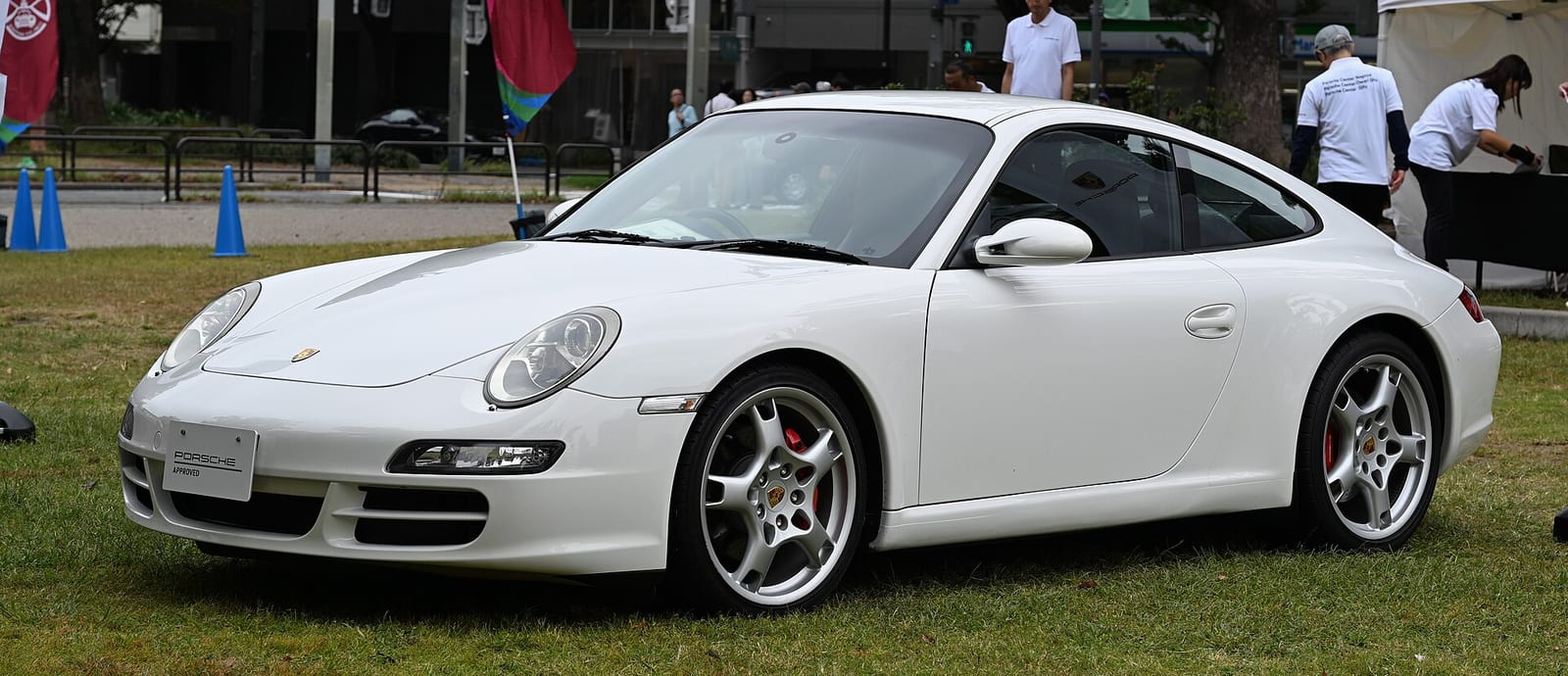
Scope: Porsche 911 Carrera S and Carrera 4S (997.1), model years 2005 to 2008, naturally aspirated 3.8-liter M97.01 engine. Not applicable to the 3.6-liter Carrera, 997.2, Turbo, GT2 or GT3. Verify VIN and engine designation.
Heavy exhaust smoke is one possible sign of a failing air-oil separator (AOS). A 997 can also develop excessive crankcase vacuum and lean-running faults without producing visible smoke. The most useful diagnostic is a measured crankcase vacuum reading, not a guess based on the oil cap or tailpipe. LN Engineering's manometer guidance documents this distinction.
Quick answer
For the M97 engine family, LN Engineering reports a nominal crankcase vacuum of approximately -4 to -6 inches of water (inH2O). A much more negative reading, such as -10 to -15 inH2O, supports investigating the AOS and ventilation system. Weak vacuum suggests leaks or measurement problems. These are specialist reference figures, not presented as Porsche factory tolerances. Source and test instructions.
Which 997 does this cover?
| Model | Engine | Applies? |
|---|---|---|
| 2005-2008 Carrera S / Carrera 4S | 3.8L M97.01 | Yes, with VIN verification |
| 2005-2008 base Carrera / Carrera 4 | 3.6L M96.05 | No, different separator |
| 997.2, Turbo, GT2, GT3 | Other engine families | No |
FCP Euro's 997 engine comparison distinguishes the M97.01 from the M96.05. The genuine Porsche 3.8-liter AOS listing explicitly excludes the base 3.6-liter engine. Replacement engines and parts supersessions make VIN checks essential.
What the AOS does
Combustion gases passing the piston rings enter the crankcase. The ventilation system routes these gases into the intake while separating oil mist and maintaining controlled crankcase vacuum. A failing separator can let crankcase vacuum rise too high, which can draw oil into the intake. A cracked hose or bad filler seal can instead reduce measured vacuum. LN Engineering's AOS explanation describes the operating principle.
Symptoms and alternatives
| Symptom | Possible AOS connection | Alternative to investigate |
|---|---|---|
| White or blue exhaust smoke | Oil drawn into the intake | Overfill, other oil-consumption causes |
| Whistle or honk | High vacuum, seal leaks or reverse flow | Accessory noise or intake leaks |
| Rough idle or lean-running faults | Abnormal crankcase ventilation | Ignition, intake and fueling problems |
| Unexplained oil consumption | Increased oil carryover | External leaks or internal wear |
| No visible smoke | AOS failure is still possible | Measure vacuum rather than dismissing it |
LN Engineering documents misfire faults without smoke. FCP Euro also describes the relationship between failed ventilation components, oil consumption, rough idle and exhaust smoke. Symptoms alone are not proof.
How to test crankcase vacuum
- Check oil level and record stored fault codes before clearing anything. Stop the engine if it has severe mechanical noise, rapidly worsening oil consumption or persistent dense smoke.
- Inspect the oil cap seal, filler neck and accessible ventilation hoses for damage. A leak here can distort the test.
- Use a slack-tube tester or manometer (an ultrasensitive vacuum gauge) with the correct oil-filler adapter. A listed 997-compatible tool is one example.
- Follow the tester's zeroing instructions. Record a stable reading with its sign and units.
- Compare the reading with the M97 reference: about -4 to -6 inH2O nominal. A more negative reading around -10 to -15 inH2O warrants investigating AOS function and associated lines.
- If vacuum is weak or near zero, check for leaks at the oil cap, filler tube, hoses and test adapter before replacing the separator.
- Correlate the reading with smoke, oil use, idle quality and stored faults. Repeat an inconsistent test before ordering parts.
Do not use the oil-cap tug test as a definitive diagnosis. Hand force is subjective. LN Engineering says the only definitive AOS test is measuring crankcase vacuum, and advises against leaving the oil cap off for long with the engine running.
Reading the result
| M97 reading | Meaning | Next step |
|---|---|---|
| About -4 to -6 inH2O | Within specialist nominal band | Investigate other causes if symptoms remain |
| About -10 to -15 inH2O or more negative | Excess vacuum is plausible | Inspect AOS and ventilation system |
| Weak or near-zero vacuum | Leak or measurement problem possible | Inspect cap, filler, hoses and adapter |
Do not apply these figures to the later MA1 engines, which use different reference readings. Do not confuse inches of water with inches of mercury.
Correct 3.8-liter part number
Porsche's historical PET catalog (dated 2006) lists 997 107 038 00 as the oil separator, item 1, in M97.01 crankcase bleeding illustration 104-11. The base-engine M96.05 illustration 104-10 lists a different part, 996 107 026 50. The current genuine Porsche retailer listing cross-references 99710703801 and describes the 2005-2008 3.8 S application. Verify the current supersession and VIN before ordering. The same PET catalog shows other oil-separation components and vent lines; similar names do not mean the parts are interchangeable.
Inspect associated plastic ventilation hoses. The retailer notes that aging lines can become brittle and crack. A new AOS cannot repair a split hose. Match each hose to the correct diagram and installed engine before purchasing.
Replacement planning and safety
The separator sits within a larger crankcase ventilation assembly. Photograph hose routing and connector positions before dismantling. Protect open intake passages from debris, work on a cooled engine and support the vehicle correctly if underbody access is necessary. Follow the complete Porsche workshop procedure for the specific VIN, engine and equipment.
Torque caution: No separator, intake or engine-support torque is given here because the available source set does not establish a complete, unambiguous tightening schedule for the exact 3.8-liter installation. Do not reuse a 3.6-liter value or a generic fastener torque. Confirm every tightening instruction in the applicable Porsche repair manual.
After repairs, restore all connections, check for leaks, rescan stored faults and repeat the manometer test to verify that crankcase vacuum has returned to the expected range.
Preventive replacement
LN Engineering and Flat 6 Innovations suggest considering AOS replacement every 6 years or 75,000 miles. That is a specialist recommendation, not a factory-mandated service interval established in this article. Use service records, measured vacuum, operating conditions and parts condition to decide.
Frequently asked questions
Can an AOS fail without smoke?
Yes. Excess vacuum and lean-running faults may precede visible smoke. Measure vacuum.
What vacuum is normal for the M97?
LN Engineering gives -4 to -6 inH2O for M96 and M97 engines. Confirm using the proper tester.
Do 3.6 and 3.8 engines use the same AOS?
No. The Porsche PET lists a different oil separator for the M96.05 (996 107 026 50) than for the M97.01. Check engine code and VIN.
What is the 3.8-liter AOS part number?
Historical PET: 997 107 038 00. The current LN Engineering listing for the genuine Porsche part cross-references 99710703801. Confirm supersession.
Can I diagnose it by loosening the oil cap?
No. Cap suction is only a clue. Use a sealed manometer test.
References
- Porsche PET 997 parts catalog, crankcase ventilation diagrams
- LN Engineering / Callas Rennsport manometer instructions
- LN Engineering AOS failure overview
- Genuine Porsche 3.8-liter AOS listing
- FCP Euro 997 engine guide
Related: Porsche 997.1 buyer's guide.
Technical disclaimer: This independent guide is not a substitute for current Porsche factory repair information or a qualified inspection. Confirm VIN, engine, production date, equipment, current part numbers and all fastener procedures. Incorrect work can cause injury, fire or engine damage. Stop running an engine with severe smoke or signs of oil ingestion.
Affiliate disclosure: This article contains no affiliate links. The retailer links are for reference.