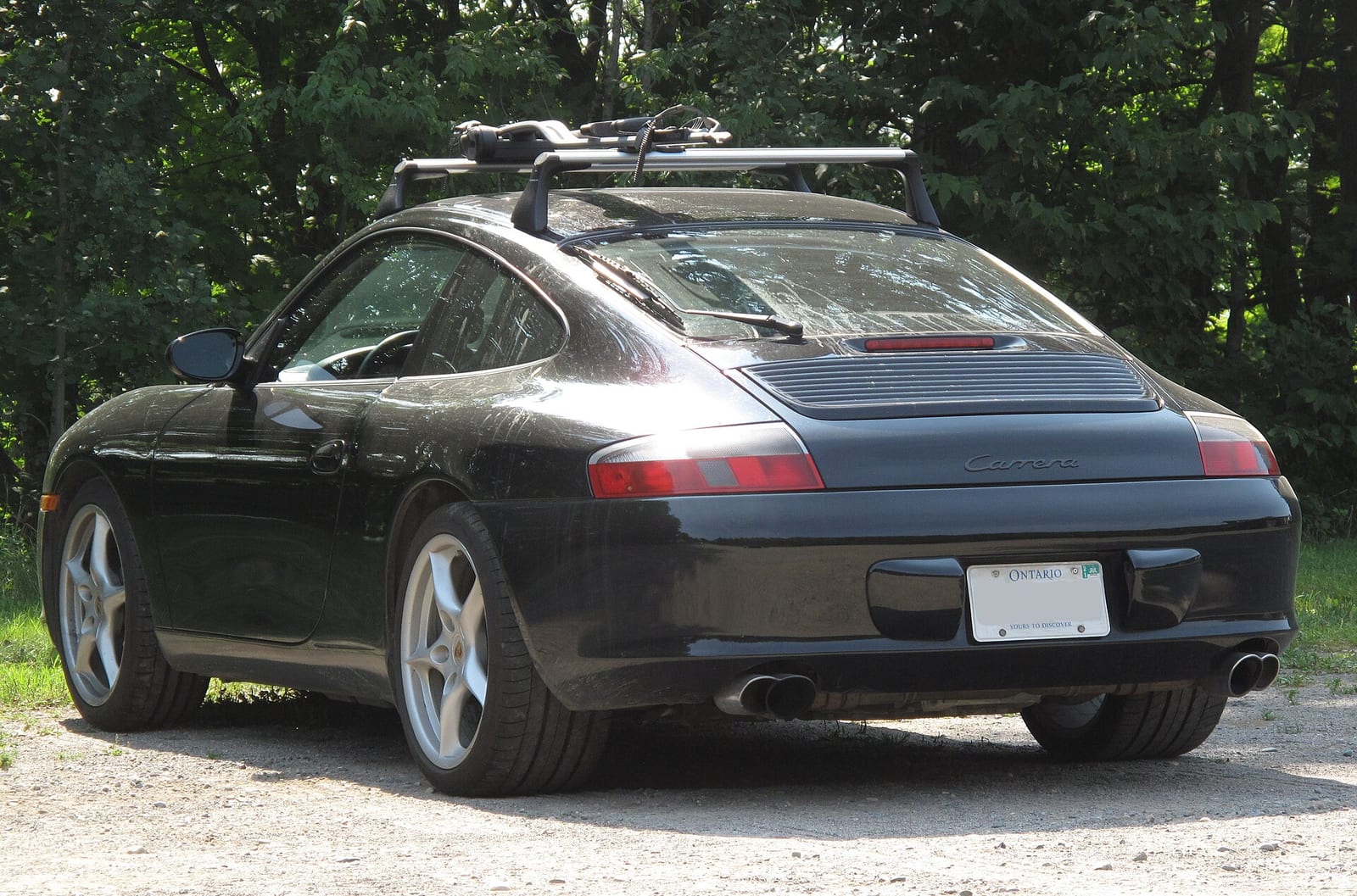
On a 1999 to 2004 Porsche 911 Carrera (996), 1 small switch at the brake pedal turns the brake lights on and tells the ABS, PSM and cruise control that you are braking. When it is out of adjustment or failing, the brake lights can stay on, flicker over bumps or not come on at all, and the cruise control can drop out on its own. This guide sorts the switch from the bulbs, fuse and wiring using Porsche's workshop manual, diagnosis manual and owner's manual. Where a point is our own advice or reading, we say so.
Affiliate disclosure: This article contains affiliate links. If you purchase through them, Department Six may earn a commission at no additional cost to you.
Symptoms and immediate safety considerations
Porsche's workshop manual describes what happens when the switch loses its setting: "The brake lights are always on or flicker when traveling over bumps. In vehicles with cruise control, the cruise control can be deactivated as a result of vehicle vibrations under certain circumstances." Porsche workshop manual, brake light switch setting.
Signs that point at the switch circuit:
- Brake lights on all the time, with the car parked and the pedal released.
- Brake lights that flicker over bumps without your foot on the pedal.
- No brake lights at all, with all 3 lamps out at once.
- Cruise control that cancels itself on rough roads.
- "ABS failure" or "PSM failure" on the on-board computer. Porsche's diagnosis manual lists fault code 4340, "Stop-light switch", for the ABS and PSM systems. For PSM it says the PSM, ABS and traction control functions are switched off when that fault is present. Porsche 996 diagnosis manual (PDF scan).
Our advice on driving: if the brake lights do not come on when you press the pedal, keep the car off public roads until they do, because drivers behind you get no warning. If the lights stay on all the time, drivers behind cannot tell when you are braking, and a stored 4340 fault can leave ABS and PSM switched off. Treat both as fix-before-driving problems.
How the brake pedal switch affects the lights
Porsche's PSM manual puts the switch in front of the brake pedal. Porsche 996 diagnosis manual. The workshop manual says it sits in a bayonet mount in the pedal block and locks by turning it 90 degrees. Porsche calls it self-adjusting: when it is installed with its plunger pulled out, the pedal pushes the plunger in to the right point. Porsche, brake light switch setting.
Porsche designed the switch travel so the brake lights come on before brake pressure builds. If the switch is "overpressed" during work on the pedals or the brake unit, that travel is lost. That is why Porsche says to readjust the switch after any job that moves the brake pedal out of its normal position.
The switch has 2 contacts. Porsche's PSM manual calls it a twin contact, make and break: 1 contact closes when you press the pedal and the other opens. The PSM control unit reads both, and if a brake application arrives during a traction control intervention, it stops that intervention and switches to ABS control. Porsche 996 diagnosis manual, PSM component description. That is why 1 switch fault can show up as brake light, ABS, PSM and cruise complaints at the same time.
Cruise control also cancels for normal reasons. Porsche's owner's manual says it is interrupted when you press the brake or clutch pedal, select N on a Tiptronic, run more than about 16 mph (25 km/h) over the set speed for over 20 seconds, or fall 6 mph (10 km/h) below it for over 5 seconds, which can happen on hills. Porsche 911 Carrera owner's manual, 2003 (PDF), pages 104 to 105. A cancel on a steep climb is normal. A cancel over a bump on a flat road fits Porsche's description of a misadjusted switch.
Rule out bulbs, fuses, wiring, and pedal issues
Look at all 3 brake lamps with a helper pressing the pedal. Our reading: 1 lamp out while the others work points to that bulb or its socket, because the switch feeds all of them. All 3 out, or all 3 stuck on, points back to the switch, its fuse or its wiring.
Bulbs. Porsche's 2003 owner's manual lists these for the 911 Carrera:
| Lamp | Base | Bulb |
|---|---|---|
| Taillight, brake light | BAY15d | P21/5W |
| Raised brake light | W2.1 x 9.5d | W3W |
Source: 2003 owner's manual, bulb table, which is the edition we used. To reach a taillight bulb, open the engine lid, remove the M6 x 15 screw and pull the taillight out to the rear. Turn the socket counterclockwise to remove it. Refit the light with its lugs seated, then test all bulbs. Porsche, tail light bulb. For the raised brake light in the rear spoiler, the owner's manual says to extend the spoiler by hand first. 2003 owner's manual, raised brake lights. Porsche's procedure then levers out the right corner segment of the lens, turns the light's lock about 90 degrees counterclockwise and releases the bulb holder's tabs. Porsche, additional brake light bulb.
Fuse. The fuse box is at the lower left of the driver's footwell, behind a plastic cover with the fuse plan printed inside. Porsche says to switch off all consumers and remove the key first, replace a fuse only with the same rating, and see a dealer if it blows again. 2003 owner's manual, page 213. On Porsche's 2002 Carrera fuse diagram, fuse B7 is 15 A and is labeled "Stop light, cruise control". Porsche, fuse assignments. Check the plan in your cover, since fuse layouts can differ by year. Our reading: a blown fuse on that shared circuit would explain dead brake lights and dead cruise control together.
Wiring. In Porsche's PSM test plan, every "no" result for the switch circuit lists 2 causes: a wiring fault between the control unit and the switch, or a faulty switch. Porsche notes the plug connections and jumper plugs sit in the harness and says to check it for pinching or chafing. Porsche 996 diagnosis manual, test 8.5.
Pedal. A pedal that does not return fully will hold the switch on. Porsche's brake pedal procedure includes a return spring for the pedal and bearing bushings that should be inspected and replaced if needed. Porsche, removing and installing brake pedal. Our advice: before blaming the switch, lift the pedal by hand and check it returns to the same height every time and nothing such as a floor mat holds it down.
Diagnose switch operation and adjustment
1. Check the switching point. Porsche's check: the pedal must move a noticeable 5 to 10 mm before the brake light comes on, and the light must come on before the pedal meets noticeable resistance or brake pressure builds. Porsche, checking brake light switch setting. A helper watching the lights makes this easy.
2. Read the fault memory. Porsche's ABS diagnosis for fault 4340 starts with the "Input signals" menu on its System Tester 2: press the brake pedal and the stop light switch display must change from "not actuated" to "actuated". Porsche, ABS input signals. Without that tester, you need a scan tool that can read Porsche ABS and PSM modules, or a dealer or specialist.
3. Test the switch. Porsche's next step is to pull the wires off the switch and test it with a multimeter, removing it if needed, then check its adjustment and the wiring against the diagram. Porsche 996 diagnosis manual, ABS test point 13. Porsche gives no resistance figures for the switch itself. 1 owner on Pelican's forum reported checking across the terminals marked on the switch: 1 and 4 closed with the plunger pushed in and open with it released, and 1 and 2 the other way around. Pelican Parts forum. That is 1 owner's report, and it fits Porsche's twin-contact description. Our reading: the plunger is pushed in when the pedal is at rest, so that is the released-pedal state.
4. Test the circuit at the PSM plug. Porsche's PSM 5.7 test plan, for the 911 Carrera and Carrera 4 from model year 2000, unplugs the PSM control unit with the ignition off, then turns the ignition on and measures each switch wire to ground at the harness side of the plug:
| PSM plug terminal | Pedal | Porsche's required reading |
|---|---|---|
| 37 (stop light switch, open) | Not pressed (no pedal step listed) | Greater than 11 V |
| 37 | Pressed | Less than 0.3 V |
| 32 (stop light switch, close) | Pressed | Greater than 11 V |
| 32 | Released | Less than 0.3 V |
Source: Porsche 996 diagnosis manual, PSM 5.7, test 8.5, pages 45-D 240 to 241. The earlier PSM section in the same manual, for the Carrera 4, uses terminals 42 and 48 for the same 2 wires. The terminal numbers differ between PSM versions, so match them to your car's control unit before you probe.
Safety for electrical tests: Porsche's PSM manual says never disconnect the battery with the engine running. Porsche 996 diagnosis manual, PSM 5.7 introduction. Its ABS notes say never pull off or push on the control module connector with the ignition on, since that can store faults. Porsche, ABS fault overview notes.
Decide between adjustment and replacement
Porsche gives 2 ways to fix a switching point that comes too late in the pedal travel. Porsche, adjusting the switch:
- In place: press the brake pedal and pull out the switch plunger. Release the pedal and check the setting again.
- Removed: turn the switch 90 degrees and pull it out. Pull the plunger out as far as it goes, then refit the switch. When fitting a switch for the first time, press it squarely against its seat. Porsche says it will not lock with the 90 degree turn otherwise, even with great force.
If the switching point comes too early, press the pedal and push the plunger into the switch by 1 notch, which you will hear click. Porsche says that cuts the pedal travel to the switching point by about 3 to 4 mm. Check the setting again afterward.
Replace the switch when:
- It wobbles in its mount. Porsche says a play-free fit is no longer certain after the switch has been fitted and removed several times, and a switch that noticeably wobbles must be replaced.
- It fails the multimeter or voltage tests above with good wiring, which is the "stop light switch faulty" result in Porsche's test plan.
- The setting will not hold. Our advice: if the lights drift back to staying on or flickering after a correct adjustment, replace the switch rather than adjusting it again.
Identify the correct replacement switch
Porsche's 996 parts catalogue lists the brake pedal switch in the pedal group (illustration 702-00) under 996 613 113 00 and 996 613 113 01. The same page lists clutch pedal switches under 996 613 114 00 and 996 613 114 01, so check the description, not just the first digits. Porsche parts catalogue, type 996, USA (PDF).
Later numbers are what sellers stock now. Pelican Parts sells the genuine Porsche brake light switch as 996 613 113 03 and lists it for the 1999 to 2005 996 Carrera, Carrera 4 and Carrera 4S. Genuine Porsche brake light switch 996 613 113 03 (Pelican Parts). The Pelican forum owner quoted above reported that the old switch on that 996 Carrera was 996 613 113 01, the new one was 996 613 113 02, and the new switch ended the ABS and PSM warnings. Pelican Parts forum. That is an owner report.
Our advice: read the number on your old switch, then give a Porsche parts counter your VIN to confirm the current number before ordering. Fit the new switch with its plunger pulled fully out, as Porsche's adjustment procedure describes.
Manual cars have a second switch at the clutch pedal. Porsche's pedal procedure says to pull its plunger out fully before fitting so it self-adjusts the same way. Porsche, brake pedal removal and installation. Our reading: since the owner's manual says the clutch pedal also cancels cruise, a cruise control that drops out while the brake lights behave normally makes the clutch switch worth checking too.
Coverage: we checked Porsche's brake light switch setting page for the 1999, 2001, 2002 and 2004 Carrera Coupe and the 2004 Carrera 4S. The procedure and figures are the same on each.
Validate brake lights and cruise control
- With a helper behind the car, press the pedal slowly. The brake lights should come on after 5 to 10 mm of travel and before you feel resistance.
- Release the pedal fully and confirm all 3 lamps go out.
- Read and clear the fault memory. Porsche says to erase ABS faults after a repair, take a short test drive, then read the memory again. Its PSM notes add that unplugging connectors during work can store new faults, so read and erase the fault memory of all control units after the repair. Porsche, PSM possible causes of fault.
- On the test drive, confirm no "ABS failure" or "PSM failure" message appears.
- Set the cruise control where it is safe, above 25 mph (40 km/h), its minimum per the owner's manual. The owner's manual says pressing the brake pedal cancels it, so check that it does. Our advice: also drive over a rough stretch with cruise set and confirm it holds.
Porsche torque values for pedal work
The switch itself has no fastener torque, since it locks with a 90 degree turn. These values apply only if you remove the brake pedal:
| Fastener | Porsche value |
|---|---|
| Pedal bearing axle | 8 to 10 Nm (6.0 to 7.5 ft-lb) |
| Hexagon nut on pedal bearing axle | 10 Nm (7.5 ft-lb) |
| Lock nut, steering outer tube | 20 Nm (15 ft-lb) |
| Clutch master cylinder (if detached) | 10 Nm (7.5 ft-lb) |
| Clutch boost spring bracket nuts | 7.5 Nm (5.5 ft-lb) |
Source: Porsche, removing and installing brake pedal. Porsche tightens the pedal bearing axle, then the hexagon nut, then the lock nut, in that order. On manual cars, Porsche warns that the clutch boost spring can come loose and cause injury, and says to pin it with a 3 mm cotter pin before working near the clutch pedal. For other 996 values, see our 996 torque specs.
Parts and tools. Switch: genuine Porsche 996 613 113 03 (Pelican Parts), after confirming the number by VIN. A multimeter covers the fuse, switch and circuit checks: automotive digital multimeter (Amazon). Bulbs for the taillights and raised brake light: P21/5W BAY15d (Amazon) and W3W (Amazon).
Sources
- Porsche workshop manual, 911 Carrera (996), via Operation CHARM: brake light switch setting (2002), also checked for 1999 and 2004 Carrera 4S; removing and installing brake pedal; tail light bulb; additional brake light bulb; fuse assignments; ABS input signals; ABS fault overview, DTC 4340; PSM possible causes of fault.
- Porsche 911 Carrera (996) diagnosis manual, group 45 (PDF scan): ABS test point 13, PSM component description, PSM fault 4340 and test 8.5.
- Porsche 911 Carrera owner's manual, 2003 (PDF): warning messages pages 95 to 96, cruise control pages 104 to 105, fuses page 213, bulbs and brake lights.
- Porsche parts catalogue, type 996, USA edition (PDF): pedals, illustration 702-00.
- Pelican Parts, genuine Porsche brake light switch 996 613 113 03, and Pelican Parts forum owner report.
Technical disclaimer: This is an independent DIY reference, not a substitute for Porsche's current repair information for your VIN. Check parts and procedures against your car. Work at your own risk.