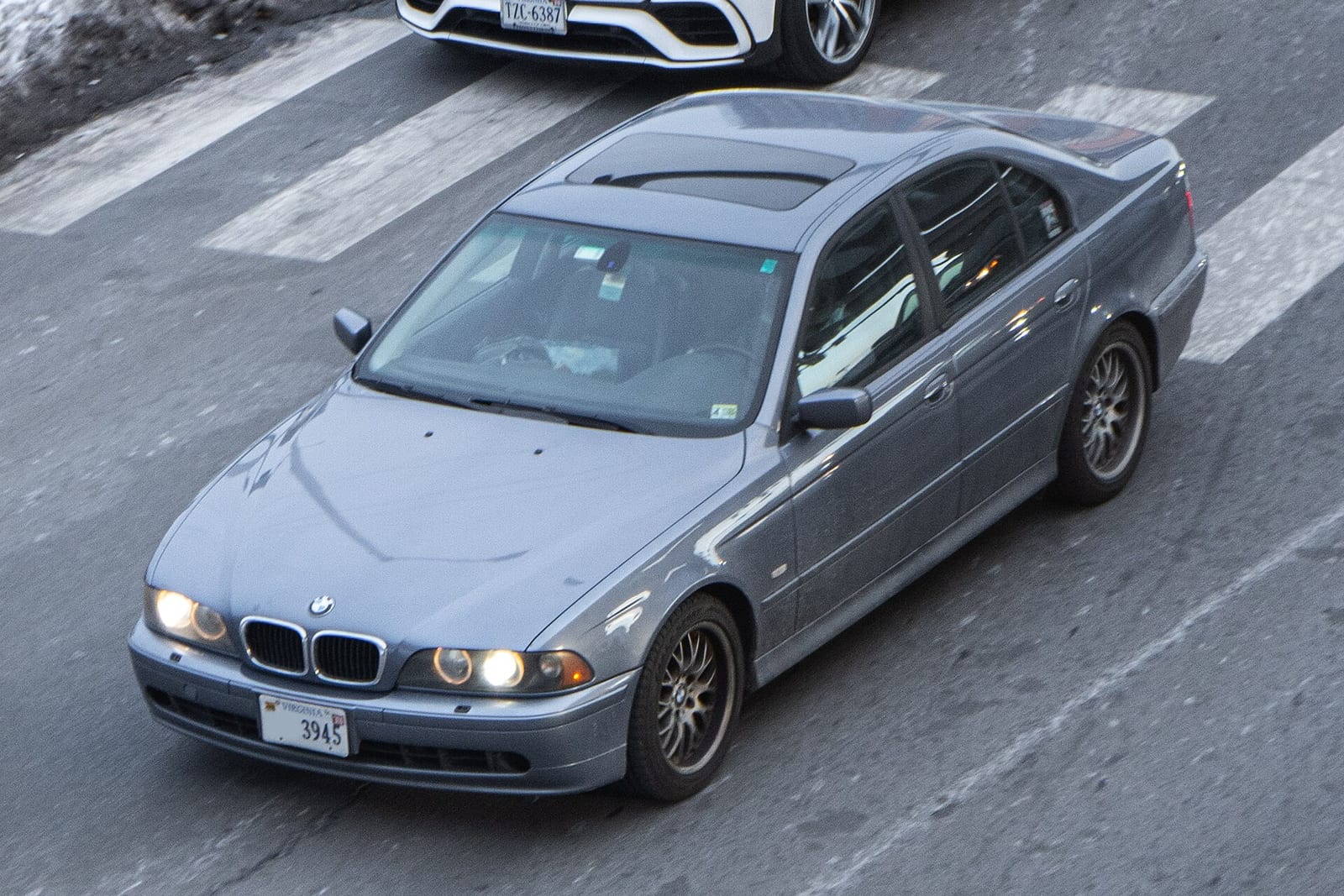
On a 2001 to 2003 E39 530i, a cabin blower that cuts out, sticks at one speed or keeps running is a complaint BMW covered in a service bulletin. BMW calls the part behind most of these cases the blower output stage, or final stage unit. It sits in the heater housing on the passenger side and sets the blower speed. This guide covers the symptoms BMW ties to that part, the checks to make before you buy one, how to find the right part number, and how to test the repair. Most of what follows comes from BMW's own repair data and service bulletins. Where a step comes from a parts shop or an owner, we say so.
Affiliate disclosure: This article contains affiliate links. If you purchase through them, Department Six may earn a commission at no additional cost to you.
Safety: BMW says the ignition must be off and the key removed before you work on interior trim or the instrument panel in a car with airbags. BMW TIS, airbag safety instructions. BMW also says to turn the ignition lock to position 0 before you disconnect or connect the battery, and to avoid sparks around it. BMW TIS, battery safety.
Scope and symptoms on the 2001-2003 E39 530i
BMW Service Information bulletin SI 64 01 99 (414), dated 03/1999 and updated 10/2001, covers E39, E46 and E53 cars with air conditioning (option 530) or automatic climate control (option 534). It describes this complaint: the heater blower fails some of the time or all the time, or keeps running at a constant speed even when you change the speed by hand. On cars with automatic climate control, the panel keeps showing the speed you set, so the display looks normal while the blower ignores it. BMW SI 64 01 99.
BMW lists the cause as a faulty blower output stage and states that the control panel is not faulty in this case. The bulletin's affected range is from the start of production until June 2001. BMW's fix is to replace the output stage.
Pelican Parts adds one more symptom: a final stage that keeps the blower running after the car is shut off and drains the battery. Pelican says the blower may run slowly and be almost silent, so listen for it with the key off. Pelican Parts, E39 final stage replacement. That is a shop article, not a BMW document.
Final stage unit versus blower motor and climate controls
BMW's E39 automatic climate control (IHKA) training manual explains how the parts work together. The control electronics sit inside the control panel, except the final stage for the blower. The final stage is mounted in a heat sink on the heater case, in the air flow on the passenger side. The panel sends the final stage a control voltage of 2.0 to 8.0 volts based on the rocker switch. The blower speeds up through 15 steps, and at 8 volts, the 16th step, it runs at full speed. BMW training manual, IHKA E39 (PDF).
The same manual lists 2 normal behaviors that can look like a fault:
- Blower speed follows battery voltage. When the battery drops below 12 volts, the panel reduces the speed signal to the final stage, so the blower may slow down. Charge or test the battery first.
- The REST feature runs the blower with the engine off. Pressing REST switches on the auxiliary water pump and blower to keep heating the cabin. With the ignition off, the blower runs at medium speed. It stops after 15 minutes, when the coolant drops below 30 °C, when battery voltage falls below 11.4 volts, or when the ignition is switched on. A blower that runs after you park and then stops within 15 minutes may be REST, not a failed part.
In automatic mode the panel sets the blower speed itself, and the bars on the display change as it does. Pressing the plus or minus blower button switches the panel to manual speed control, according to the same manual. Do your blower tests in manual mode so the speed only changes when you change it.
How the 3 parts sort out:
- Display shows your setting, blower ignores it, or blower is stuck at one speed: this is the pattern BMW's bulletin assigns to the final stage.
- Blower changes speed at every step and stops when switched off: the final stage is doing its job, so look elsewhere for the complaint.
- Panel display or buttons do not respond: that points at the control panel or its power supply, not the final stage.
Electrical checks to establish the fault
BMW does not publish E39 wiring diagrams, pin assignments or connector locations in its repair manual. TIS says that from the E38 on, schematics, installation locations and pin allocations are in BMW's diagnosis system (DIS). BMW TIS, control units, switches, relays. That is why this guide does not list fuse numbers or pin numbers. Use the fuse chart for your car and a wiring diagram for your VIN before probing anything.
- Battery. Check battery voltage and the terminals first, since low voltage slows the blower by design.
- Stored faults. BMW's training manual says the IHKA module stores up to 6 faults in memory that survives a battery disconnect, and that output faults switch off the failed output. A scan tool that can read BMW's climate control module can show them.
- Fuse and relay. BMW's training manual lists a blower relay along with the final stage on the IHKA system. Check the blower fuse and relay for your car before you buy parts.
- Connector. BMW's parts catalog lists a 5-pin socket housing on the final stage harness for the US 530i. RealOEM, 530i automatic climate control electrical parts. One Pelican reader found 2 charred receptacles in that connector, and Pelican staff said to replace them if burnt and to check the blower ground for voltage drop. Treat that as one owner's report, but look at the connector while it is out.
- Control signal. With a wiring diagram, a multimeter on the control lead should show the 2.0 to 8.0 volt range from BMW's training manual as you step the speed up. A signal that changes while the blower does not points at the final stage or the blower motor. No change in the signal points back at the panel or wiring.
Access, inspection, and repair decision
The final stage is the easy part to reach. BMW's repair instruction 64 11 222 lists 4 steps:
- Remove the panel on the right side of the center console.
- Remove the cover from the underside of the glovebox.
- Unfasten the plug connection and disconnect it.
- Unlock the final stage and pull it out.
BMW TIS 64 11 222. Pelican's photo guide shows the same job on an E39: the panel under the glovebox slides toward the back of the car, removing the carpeted panel beside the transmission tunnel (1 fastener) gives a better view, and the final stage comes out with its connector still attached. Pelican lists a Phillips screwdriver as the only tool and says much of the work is done by feel. One Pelican reader with a 2001 530i found 2 screws holding the unit and broke them by pulling, so look for screws before you pull.
The blower motor is a much bigger job. BMW's procedure 64 11 210 starts by removing the upper instrument panel trim (51 45 050). BMW TIS 64 11 210. That trim job requires removing both A-pillar panels, the lower instrument panel trim, the complete instrument carrier and the passenger airbag. BMW TIS 51 45 050. The lower trim job starts with disconnecting the battery negative lead. BMW TIS 51 45 030. Then the blower cover comes off its clips and the blower is unplugged and unbolted. BMW TIS 64 11 210, page 2. Because of that gap in effort, rule out the final stage before you commit to the motor.
BMW's bulletin gives labor of 1 flat rate unit on an E39 when the final stage is replaced during another workshop visit, and 3 units when it is the only job. BMW SI 64 01 99, page 2.
BMW data at a glance
| Item | BMW value | Source |
|---|---|---|
| Battery lead screw connection, M6 | 5 Nm | TIS 61 21 |
| Battery lead screw connection, M8 (E38, E39) | 15 Nm | TIS 61 21 |
| Final stage control voltage (IHKA) | 2.0 to 8.0 V | BMW training manual |
| Final stage fasteners | No torque listed in TIS | TIS 64 11 222 |
For other E39 values, see our E39 torque specs reference.
Replacement fitment and production-date questions
BMW's bulletin says to order the output stage as per BMW's parts catalog, not by a fixed number. For the US 530i, RealOEM shows final stage unit 64 11 6 923 204 in both climate control diagrams: electric parts for automatic air conditioning and electric parts for AC unit.
RealOEM's cross-reference lists 64 11 6 923 204 as the current part. It supersedes 4 earlier numbers, and the 3 most recent are marked exchangeable retrospectively, meaning the new part replaces the old one on earlier cars: RealOEM part cross-reference.
| Earlier part number | Dates shown by RealOEM |
|---|---|
| 64 11 8 364 173 | 09/1995 to 02/1999 |
| 64 11 8 385 549 | 09/1998 to 07/2002 |
| 64 11 6 929 486 | 07/2002 to 03/2003 |
| 64 11 6 920 365 | 09/2003 to 01/2014 |
If one of the 3 later numbers is printed on your unit, the current part replaces it. Confirm the number against your own car in the parts catalog by VIN before you order, since BMW's parts data is the reference the bulletin points to.
Post-repair blower operation checks
BMW's procedure does not list a separate test. These checks follow the complaint in BMW's bulletin:
- Refit the unit so it sits firmly. Pelican says there is a hole in the final stage body that has to line up with a pin on the heater housing, which keeps the unit from moving.
- Reconnect the plug, switch on the ignition and set the blower to manual control.
- Step through all 16 speeds and back down. The blower should change at each step and match the display.
- Step down to the lowest setting and toggle the blower off, as BMW's training manual describes, and confirm it stops.
- Switch the ignition off, remove the key and listen at the passenger footwell. Unless you pressed REST, the blower should not run.
- Drive the car and repeat the speed check after the cabin has heated up, since the original complaint can be intermittent.
When further diagnosis is needed
- Cars with the manual climate panel (IHKR). BMW bulletin SI 64 05 01 (740) covers E39 cars built until June 2001 where the blower does not start after ignition on, only when the blower knob is slightly left of center, near the 11 o'clock position. Moving the knob starts it again. BMW lists the cause as a software error in the control panel and the fix as a new panel, part 64 11 6 915 282 for US E39 cars. Cars with automatic climate control are not affected. BMW SI 64 05 01.
- The new final stage changes nothing. Go back to the control signal and the blower motor checks. A control signal that changes with the rocker switch while the blower does not points at the blower motor or its power and ground.
- The automatic panel itself is replaced. BMW says recoding is needed after replacing the automatic climate control panel (64 11 749). BMW TIS 64 11 749.
- The battery still drains with a new final stage. One Pelican reader replaced both the final stage and the climate control panel and still had to disconnect the battery. Pelican staff pointed to a shorted wire to the final stage, and another reader suggested the blower relay. These are owner and shop suggestions, not BMW test steps.
Parts and tools. A multimeter helps with the battery and control signal checks: automotive digital multimeter (Amazon). Replacement final stage for the E39 530i: URO blower motor resistor 64 11 6 923 204 (Turner Motorsport). Turner lists the E39 530i M54 in its fitment table. Confirm the part number for your VIN first. Thinking about buying an E39? See our 525i vs 530i manual guide.
Sources
- BMW Service Information SI 64 01 99 (414), heater blower fails or runs permanently: page 1 and page 2.
- BMW Service Information SI 64 05 01 (740), IHKR blower setting: page 1.
- BMW TIS repair instructions: 64 11 222 final stage, 64 11 210 heater blower, 51 45 050 upper instrument panel trim, 51 45 030 lower instrument panel trim, 64 11 749 climate control panel, airbag safety, battery safety, control units and DIS.
- BMW TIS tightening torques: 61 21 battery with terminal.
- BMW technical training, IHKA E39 (PDF).
- BMW parts catalog via RealOEM: 530i automatic climate electrical parts, 530i AC unit electrical parts, 64 11 6 923 204 cross-reference.
- Pelican Parts, E39 blower motor final stage replacement, including reader comments.
Technical disclaimer: This is an independent DIY reference, not a substitute for BMW's current repair information for your VIN. Production changes affect parts and procedures. Work with the ignition off and at your own risk.